
Pamex proudly sponsor, KIN Research Award at Dublin Dental University Hospital in association with Trinity College Dublin
Pamex is proud to sponsor the KIN Research Award at Dublin Dental University Hospital, in association with Trinity College Dublin. The award supports dental research, including two ongoing clinical trials exploring the potential role of platelet-rich fibrin in dental implant treatment.
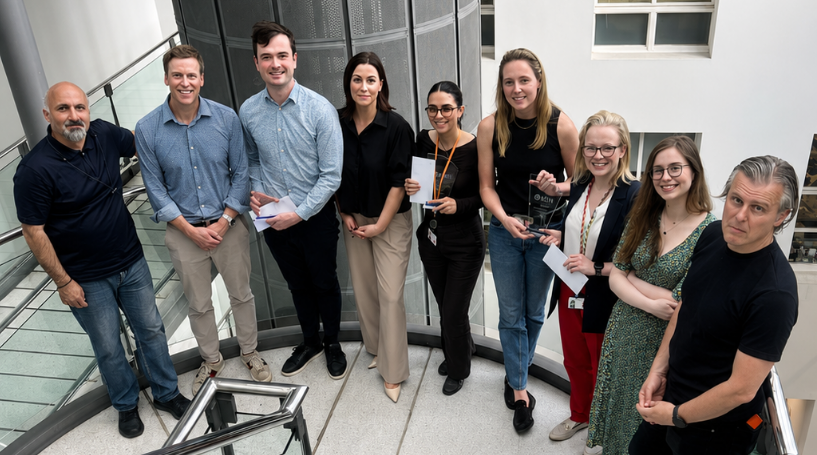
Congratulations to Daniel Merrick, winner of the Best Clinical Doctorate Research Award, and runner-up Rawan Kahtab, as well as Best Literature Review Award winners Dr. Jessica Rice and Emma McShane. We also congratulate all presenters and supervisors for their dedication to advancing oral healthcare.
Please see below for details of the clinical trials conducted by Daniel Merrick and Rawan Kahtab.
A Randomised Control Clinical Trial Investigating the Effect of Leukocyte and Platelet-Rich Fibrin (L-PRF) on Implant Stability and Marginal Bone Levels by Daniel Merrick
Successful dental implant treatment is dependent on predictable osseointegration, the development of primary and secondary stability and long-term maintenance of peri-implant bone levels. These biologic and mechanical factors are closely interrelated and collectively determine implant survival, prosthetic success and the establishment of healthy peri-implant soft tissue. Autogenous Platelet Concentrates (APCs), particularly Leukocyte and Platelet Rich Fibrin (L-PRF) have been proposed as a biologically active agents with the potential to modulate bone regeneration, wound healing and dental implant osseointegration through local delivery of platelets and leukocytes and sustained release of growth factors.
The primary aim of the study was to determine whether the adjunctive use of L-PRF during implant placement improves primary and secondary implant stability compared with conventional implant placement at baseline, 3 months and 5 months. The secondary aim was to determine the effect of L-PRF on marginal bone levels when compared to conventional implant placement. The trial was a parallel-arm randomised control trial. Ethical approval was sought and approved in 2024 and this study was registered with Clinicaltrials.gov prior to recruitment commencement.
Participants who met the inclusion criteria were invited to participate in the study and were randomly allocated to either the test or control group. In the test group, a blood sample was collected and centrifuged to produce a leukocyte- and platelet-rich fibrin (L-PRF) membrane, which was placed into the osteotomy site during implant placement. Participants in the control group underwent conventional implant placement without the use of L-PRF.
Implant stability was assessed using resonance frequency analysis (RFA) and recorded as Implant Stability Quotient (ISQ) values. Additional outcome measures included clinical and radiographic marginal bone levels. Potential confounding variables, including implant length, implant diameter, soft tissue thickness, and insertion torque, were also recorded.
Data collection is ongoing and final analysis of the results has yet to take place. Preliminary results comparing test and control groups have not demonstrated any significant differences in implant stability, or marginal bone levels across the timepoints recorded. However, the complete dataset must be collected and analysed before any definitive conclusions can be drawn.
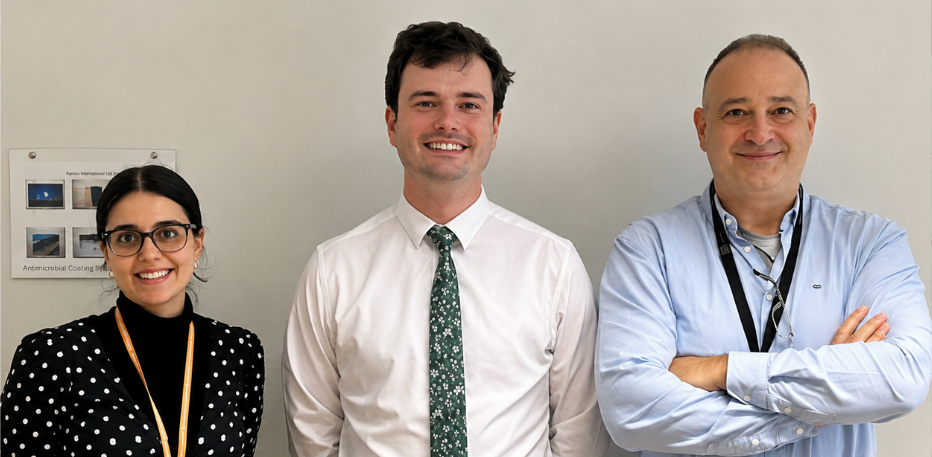
L-R: Rawan Kahatab, Daniel Merrick, Prof. Ioannis Polyzois.
A Randomised control clinical trial investigating the effect of Horizontal-Platelet-Rich Fibrin (H-PRF) on implant stability and marginal bone levels by Rawan Kahatab
Successful dental implant therapy depends on predictable osseointegration and the maintenance of adequate implant stability throughout the healing period. Platelet-rich fibrin (PRF) has been proposed as a biological adjunct capable of enhancing bone healing through the release of growth factors, cytokines, and leukocytes. Horizontal platelet-rich fibrin (H-PRF) is a novel evolution of conventional PRF produced using horizontal centrifugation, resulting in higher concentrations of regenerative cellular components. While previous studies have demonstrated some improvements in implant stability with conventional PRF preparations, there remains a paucity of evidence regarding the clinical effects of H-PRF during implant placement. This study was therefore designed to investigate whether the application of H-PRF to dental implants could improve implant stability and preserve marginal bone levels when compared with standard implant placement protocols.
This study is a prospective parallel-arm randomised controlled clinical trial conducted at the Dublin Dental University Hospital. Fifty adult patients requiring dental implant placement in the maxilla or mandible were recruited and randomly allocated to either an intervention group or a control group. Participants were selected according to predefined inclusion and exclusion criteria to minimise confounding factors affecting osseointegration and wound healing.
For participants allocated to the intervention group, venous blood was collected immediately prior to surgery and processed using a horizontal centrifugation protocol to produce H-PRF. Implants were coated with H-PRF before placement. Control implants were placed using the same surgical protocol without H-PRF application. Implant stability was assessed using resonance frequency analysis and recorded as Implant Stability Quotient (ISQ) values. Measurements were obtained at implant placement, second-stage surgery, and definitive prosthesis delivery (up to 5 months post-placement). Secondary outcome measures included marginal bone levels, insertion torque at implant placement, and patient-reported pain during the first postoperative week. Demographic and site-specific variables were also recorded for analysis.
The study is ongoing, and data collection has not yet been completed. Preliminary analyses have not identified statistically significant differences between groups with respect to implant stability, or marginal bone levels at the time points assessed. However, the complete dataset must be collected and analysed before any definitive conclusions can be drawn. Final results will be reported following completion of data collection and statistical analysis, with publication in a peer-reviewed scientific journal anticipated in 2027.
Prof. Bahman Honari, Prof. Padhraig Fleming, Daniel Merrick, Jeannette Maguire (Pamex), Rawan Kahtab, Emma McShane, Dr. Jessica Rice, Amy Fisher, and Prof. Hal Duncan.